

 STUDIO NUMBER SIX ORIGINAL
 2026/10/11
 24K
 17min
The Truth About Jimmy Page’s Session Years
Before Led Zeppelin, Jimmy Page spent several years working behind the scenes in London’s recording studios. He played on hit singles, worked alongside some of the biggest names of the Sixties and learned how records were made long before he became a producer himself.
But Page’s session career has also become surrounded by myths. Over the years, he has been credited with guitar parts he didn’t play, while some of his genuine appearances remain largely unknown.
Becoming a Session Guitarist
Page was still a teenager when he began finding regular work in London’s recording industry.
One of his earliest important sessions was Jet Harris and Tony Meehan’s Diamonds, which reached number one in Britain in Nineteen Sixty-Three. Page played acoustic guitar on the recording, despite not yet being able to read conventional musical notation. He could follow chord charts, learn quickly and, crucially, understood the rock and roll and blues sounds producers increasingly wanted.
Work soon became constant.
At his busiest, Page later remembered playing at least three sessions a day, five days a week, often with additional work at weekends. He moved between studios operated by Decca, Pye, EMI and Philips, never quite knowing what the next job would require.
The records might have been completely different, but the basic requirement remained the same: understand what the producer wanted and deliver it quickly.

Jimmy Page became one of London’s busiest young session guitarists during the early Sixties.
The Records He Really Played On
Because session musicians often went uncredited, establishing exactly what Page played on can be surprisingly difficult.
In Nineteen Sixty-Four, he took part in the recording of Them’s Baby, Please Don’t Go. Page later confirmed that he was there, although the extent of his contribution has been debated. Them guitarist Billy Harrison maintained that the famous driving riff and lead guitar were his, while Page has been associated with additional rhythm guitar.
That same year, Page found himself working on something completely different.
On the seventh of September, he was among the guitarists at Abbey Road for Shirley Bassey’s recording of Goldfinger. Page later remembered Bassey holding the song’s enormous final note until, according to his recollection, she collapsed from lack of breath when the take ended.
For Page, these wildly different sessions could simply be another day at work.
The Kinks and The Who Myths
Page’s work with producer Shel Talmy placed him around two of the most important British groups of the period: The Who and The Kinks.
He was brought in for The Who’s I Can’t Explain, but not to replace Pete Townshend. Page later explained that he was effectively there as insurance in case he was needed. Townshend played the important guitar parts, although Page did play fuzz guitar on the B-side, Bald Headed Woman.
An even bigger story developed around The Kinks.
For years, Page has been credited by some with playing the famous guitar solo on You Really Got Me. Both Page and Dave Davies have rejected that claim. Davies played the solo and was responsible for the distinctive distorted guitar sound that helped make the record famous.
Page did work on other early Kinks sessions, which helped the story survive.
As his reputation grew, his genuine session career became mixed with legend. If a striking guitar part appeared on a British record from the period, somebody eventually seemed to suggest Jimmy Page had played it.

Page’s extensive session career eventually led to him being credited with recordings he repeatedly said he did not play on.
What Page Was Really Learning
The most important thing Page took from his session years may not have been the records themselves.
He was watching how they were made.
Working in so many different studios allowed Page to observe producers and engineers at close range. He learned about microphone placement, room sound and the difference seemingly small recording decisions could make.
Page became particularly interested in the old recording principle that “distance makes depth”. Instead of placing every microphone as close to an instrument as possible, allowing a microphone to capture the surrounding room could give a recording a much greater sense of space.
He was also experimenting with effects. During his time with The Yardbirds, Page explored backwards echo and other techniques that would later become part of his approach to production.
By the time The Yardbirds collapsed in Nineteen Sixty-Eight, Page had spent years learning both sides of the recording process.
He was a guitarist, but he was increasingly thinking like a producer.
From Session Man to Led Zeppelin
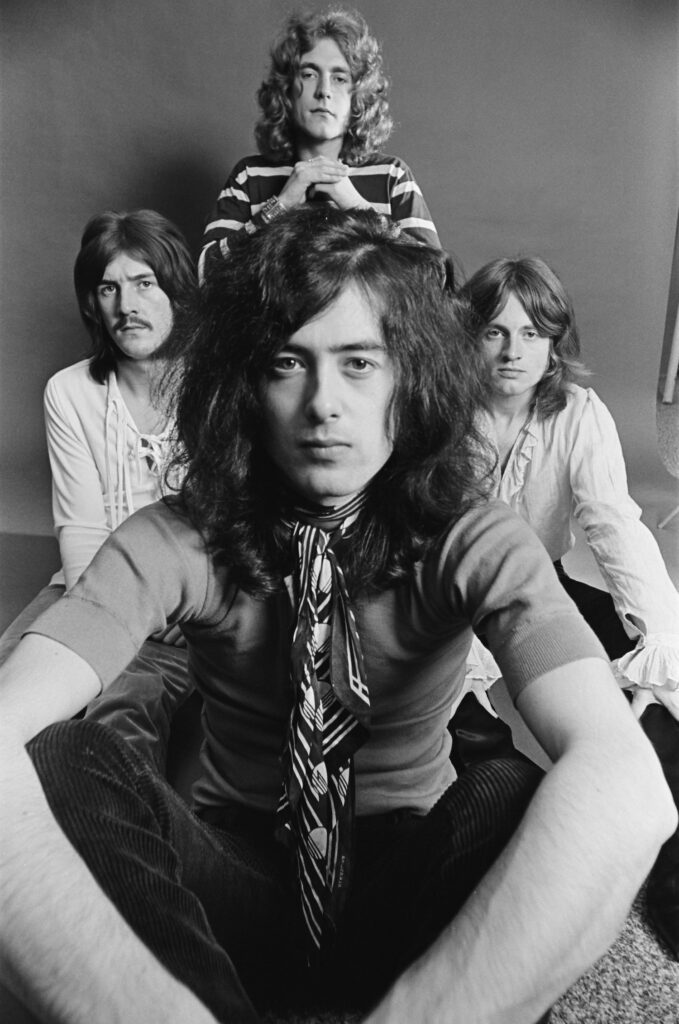
After The Yardbirds ended, Page assembled a new group with Robert Plant, John Bonham and John Paul Jones.
The four musicians first played together in August Nineteen Sixty-Eight. After a short Scandinavian tour as The New Yardbirds, they entered Olympic Studios in London.
This time Page wasn’t waiting for somebody else to tell him what to play.
He was producing the record.
Page financed the sessions himself, giving him the freedom to make the album before presenting the finished project to a record company. Led Zeppelin’s debut was recorded and mixed in just over thirty studio hours, at a cost of around one thousand, seven hundred and eighty-two pounds.
The speed of those sessions made far more sense when Page’s previous career was taken into account. He knew how professional studios worked, understood the importance of preparation and already had strong ideas about how instruments should be recorded.

When Led Zeppelin entered Olympic Studios, Page was able to put years of experience behind other people’s records into his own.
The Education Behind Led Zeppelin
Jimmy Page’s session career will probably always attract arguments about exactly which records feature his guitar.
But the bigger story is what those years gave him.
Long before Led Zeppelin, Page had spent countless hours watching producers, engineers and musicians make records. He had learned what worked, what didn’t and how quickly a well-prepared group could operate in a professional studio.
When Led Zeppelin finally gave him complete control, he wasn’t starting from scratch.
He had been preparing for it for years.
Before Led Zeppelin, Jimmy Page was one of London’s busiest session guitarists. The full documentary separates the genuine recordings from the myths and reveals how those anonymous years helped Page develop the studio knowledge he later brought to Led Zeppelin.
 On This Day

 November 8, 1971


 Join Backstage Pass